
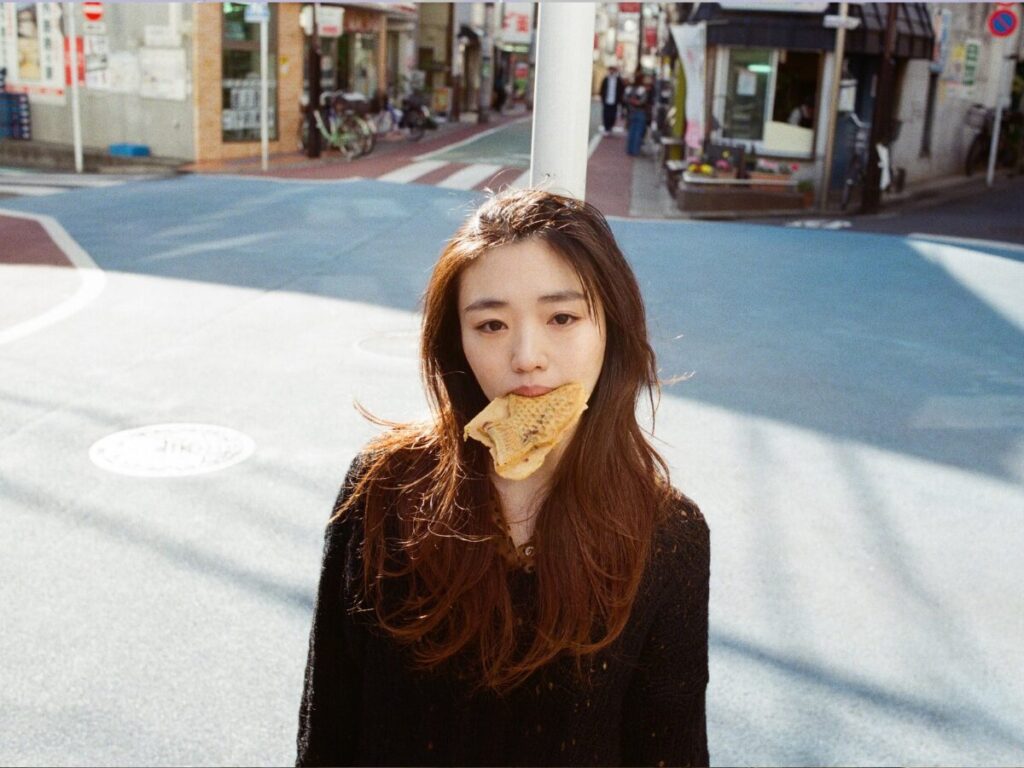
Releasing after three and a half years, Nishina’s 3rd album “Hibi Sanman” (Scattered Days). Woven together along the two axes of “daily life” and “distraction” with a voluminous 21 tracks, what has this work changed in her, and what has it left as is? From the behind-the-scenes of her production to her views on life and death as a single human being, we recorded her current words.
The Structure of the 3rd Album “Hibi Sanman”
――Could you tell us the reason why you decided to name this album “Hibi Sanman,” and the intention behind dividing it into Discs 1 and 2?
Nishina: It’s really been three and a half years, and before I knew it, songs had piled up and it was like I had to put out an album. When I thought about how to bring these 21 songs together, I struggled with the title, but as I listened through all the tracks continuously, two axes emerged. One was a truly everyday, daily life aspect, and the other was a chaotic, disorganized part—which I felt made up either myself or the songs. By smashing those two axes together, the phrase “Hibi Sanman” (Scattered Days) somehow popped up. I felt like this could bring the album together, so it became the title.
Then, while figuring out how to organize it, the idea came up to divide it into two discs, “Hibi” (Days) and “Sanman” (Scattered). So it’s two discs, but there isn’t a strict rule like “the first disc is daily life songs” and “the second disc is scattered songs.” Whether you listen to 1 and 2 separately or connect them, I built it while prioritizing creating a wave that wouldn’t get boring.
――If you had to name a symbolic track from each disc, which would they be?
Nishina: With my current feelings, “Hibi” is “weekly,” and “Sanman” is “Panda Girl.”
I wrote “weekly” while expressing that cycle from my student days, like how Mondays starting was the worst, but thinking, “Well, taking it all together is fine, it’d be nice if we could just enjoy it.”
As for “Panda Girl,” just from the fact that it starts with saying “tick-tock, tick-tock,” I feel like it’s a bit crazy. The song itself was written as the ending theme for the anime “Ranma 1/2”. The worldview of Ranma is this nonsensical place where guys turn into girls and dads turn into pandas. I wanted to enjoy that sense of things flipping upside down in the song as well, so I wrote it hoping that the up, down, left, and right of space, as well as the up, down, left, and right of ideologies and genders, would get all mixed up. So I think it ended up being the most “scattered” song.
Approach to the Songs and Changes
――I thought the track for “Ada Ada” had elements of hip-hop and hyperpop. What inspired you to try that?
Nishina: Regarding “Ada Ada,” I originally wanted to challenge myself with the Afrobeats genre. Looking back at my childhood, my mother listened to a lot of Western music, and R&B and Black music were always playing, so I always liked that laid-back beat feel.
Within that, there isn’t really anyone doing Afrobeats in J-POP lately, but in Japan, especially people in hip-hop are doing it. I’ve always been curious about what would happen if I approached this beat, so I kept saying everywhere, “I want to do Afrobeats.” Then, I told Yaffle-san, “I want to try this,” and we went into the studio together, made the track, and I took it home to turn it into a song. It’s a track born from trying what I wanted to do, and it fit into the album quite smoothly timing-wise.
――When I heard the beginning of “Oto ni Natte Iku yo” (Turning Into Sound), I felt like you were self-sampling your debut song “Rendezvous”.
Nishina: As I was making this song, I thought, “This sounds so much like ‘Rendezvous’.” Even when making the melody, maybe the chord progression is the same, but “Rendezvous” just kept popping into my head. At first, I thought that might be bad, so I asked various people, “I made this song, but doesn’t it sound a bit like Rendezvous?” Some people said it didn’t bother them at all, while others were like, “True.”
While thinking about what to do, I wondered if it’d be okay to just boldly make the intro a self-sampling kind of thing. I was suddenly struggling with what lyrics to fit there, so even if I took that approach, I’d be happy if long-time listeners could enjoy it and think, “Oh, it’s that!” Since it’s the 3rd album, I thought it would be interesting to pull from a song on the 1st album, so I went with that vibe.
――Comparing your state of mind during the “Rendezvous” era and now, is there anything you feel?
Nishina: I don’t really have a conscious sense of “this changed during production,” but while making “Oto ni Natte Iku yo,” I gained a sense of acceptance in myself like, “I really am going to live and eat by making songs.” Because of that, this song expresses the ideology of turning daily communication with people—family, friends, people I love—into music, whether we clash or click. I think this was the first song that really showcased my day-to-day life as a musician. I felt it was an “Oto ni Natte Iku yo” that I could only write right now.
Musical Exploration and the True Nature of “Madness”
――From when you started your musical activities until now, has there been any change in your feelings toward the people you want to listen to your music?
Nishina: I feel like that hasn’t changed much. When I started making songs in high school, I wasn’t making them for anyone. Once people who listened to my music gradually appeared, my feeling of wanting to leave songs from my daily life and hoping they reach someone has remained unchanged.
――Are there any new genres you’ve added to what you’re listening to now?
Nishina: I always try to look for new encounters. If I forget to explore, I’ll just get stuck on the songs I used to listen to. I listen to things with a downer mentality, and I also listen to dog-walking songs like, “Let’s go for a walk.” I feel like I’ve become able to listen to all sorts of music without preconceptions.
――Regarding the phrase “harboring transience and madness” in your profile. Are there any parts of this work where you think that “madness” came out?
Nishina: Reading my own profile like this makes me shy, since I’m not the one saying it (laughs).
If I had to answer something to that myself, I think it’s a fine line. For example, with “Glory,” behind wishing for peace, things are happening that we haven’t truly seen but want to look away from, and maybe that’s close to madness. As for the next track, “Twinkle Little Star,” when you think about what freedom is, to put it extremely, dying is also that person’s freedom, isn’t it? But because of that, I think you can go anywhere. That’s also a fine line; I think it’s both madness and the joy of living.
The Scenery of Tokyo, the Vitality of Overseas
――To you, being born and raised in Tokyo, how do you see the city of Tokyo?
Nishina: When I was little, I didn’t think much about it, but as I met various people who moved here from other countries or prefectures, I realized everyone’s image of Tokyo is truly different. For me, year by year, the realization that this is my hometown grows stronger, and I feel it’s a warm, soft city for me.
There is a part of me that is growing to love the cityscape of Tokyo more each year. For example, early in the morning, if you run toward the city center, the sunlight reflecting off the buildings or when it’s foggy. I’m sure there are things born precisely because it’s this city. Morning Tokyo is highly recommended.
――I heard you went overseas a lot last year as well.
Nishina: I went to Hong Kong, Taiwan, Shanghai, Malaysia, New York, and so on. I haven’t done any live shows overseas yet, though. Even if the language doesn’t perfectly translate, when you go abroad, kind people are kind, and because we’re human, there are times we click or don’t. I always feel that. I think that’s interesting. Also, I feel a sense of vitality from everyone. “So this is how they walk toward their jobs here, these people are so cool”—I think that no matter which country I visit.
Facing the Future
――What kind of artist do you want to become in the future?

photo by Daiki Miura
Nishina: Man, that’s really difficult. At the timing of an album release, I get asked things like “Where are you heading next?”, so I think about it a lot. It’s both a good and a bad trait of mine, but I really don’t have one. I think it would be so cool if I could say something like, “I’m going to stand up there, so follow me!”
What I think recently is that the thing I want to gain isn’t something huge. I just want to cherish and bring happiness to the people within my reach, and I want to leave behind a way of living born from my true self and the communication with the people I meet. To keep doing that until I get bored of it is my true feeling. “I want to stay light on my feet” is the most important thing.
At the beginning, I had no choice but to work frantically, but arriving at this point, I really want to prioritize how I want to live as a single human being. I think now that maybe that is my goal.
――How about the tour starting in March?
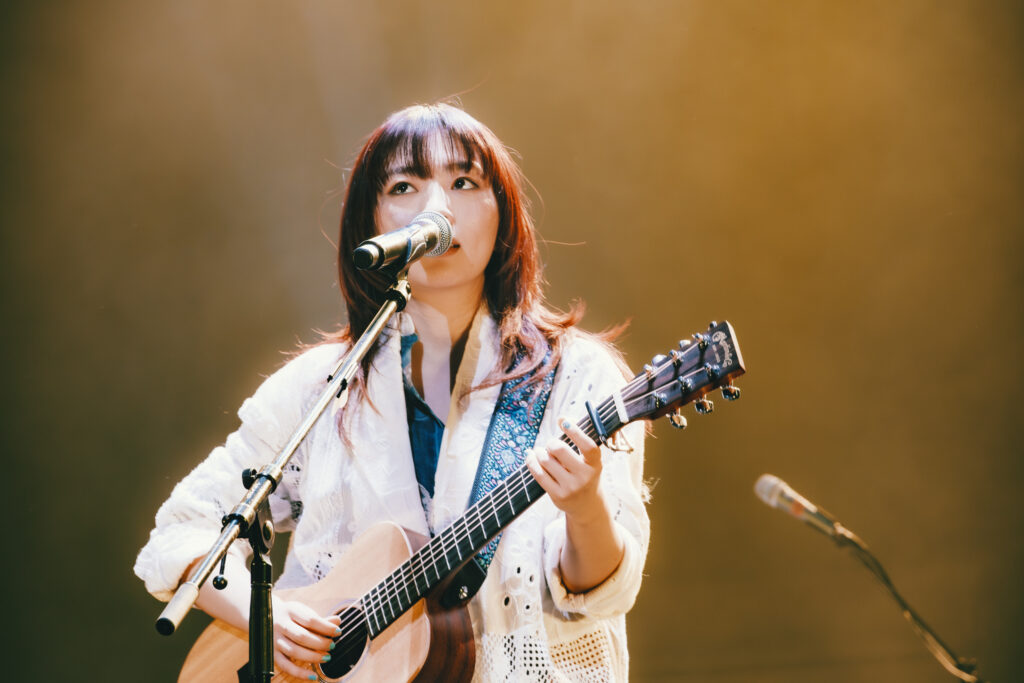
photo by Daiki Miura
Nishina: Live shows are living things; no matter how many times you do them, they’re definitely different, and I think that’s interesting. I’m also looking forward to the groove with the band members accelerating as we head into the latter half. As for how to get through it, I try not to worry too much about my throat condition and things like that. Once I start worrying, I’ll worry up to 100% (laughs). I try not to sweat the small stuff and just broadly enjoy it. Of course, I want to play at live houses, but someday I’d also love to perform at aquariums or planetariums, places other than live houses.
During the interview, she repeatedly said, “I want to stay light on my feet and in a natural state.” The 21 songs packed into her 3rd album “Hibi Sanman” are rooted not in artistic ambition, but in “daily life” and “a sense of acceptance” as a single human being. Like the morning light of Tokyo, her journey of turning the casual scenery of everyday life into sound will surely become even freer and lighter from here on out.