
“Mikugaze” — where roaring noise guitars melt into the crystalline voice of Hatsune Miku. nerdneko, an artist who continues to expand his own unique sonic world within this scene, has just released a new EP, never mind.
The theme of this work is “a prayer for the distant future.” Born against the backdrop of negative emotions he himself has faced — a cancelled overseas tour, an unstable world situation — the sonic imagery that emerged is by no means pessimistic. Behind the words “never mind” lies a “strength to let go by one’s own will,” and a gentle prayer that drifts across a sea of noise.
We spoke with nerdneko himself about the sound production, which has deepened further from his previous work, and the personal intentions woven into each track.
—— The theme of this work is “a prayer for the distant future.” Since your last interview, what changes in your state of mind or sources of inspiration led you to this theme?
nerdneko: My China tour scheduled for December was cancelled, and with the instability of the global situation and the various unreasonable things happening around me, there was a period where my attention was drawn toward the negative. That led me to want to create a work that offered some form of salvation as its overall framework.
—— We heard that behind the words “never mind,” the title carries a powerful message of “the strength to let go by one’s own hand.” Could you tell us why you chose this phrase as the title of the EP?
nerdneko: I wanted to affirm a kind of “strength” — the ability to choose and act as the subject of one’s own life — in contrast to the bravado or resignation of saying “never mind” while actually bearing everything alone and pushing yourself too hard. There’s also an element of how the phrase simply sounds good.
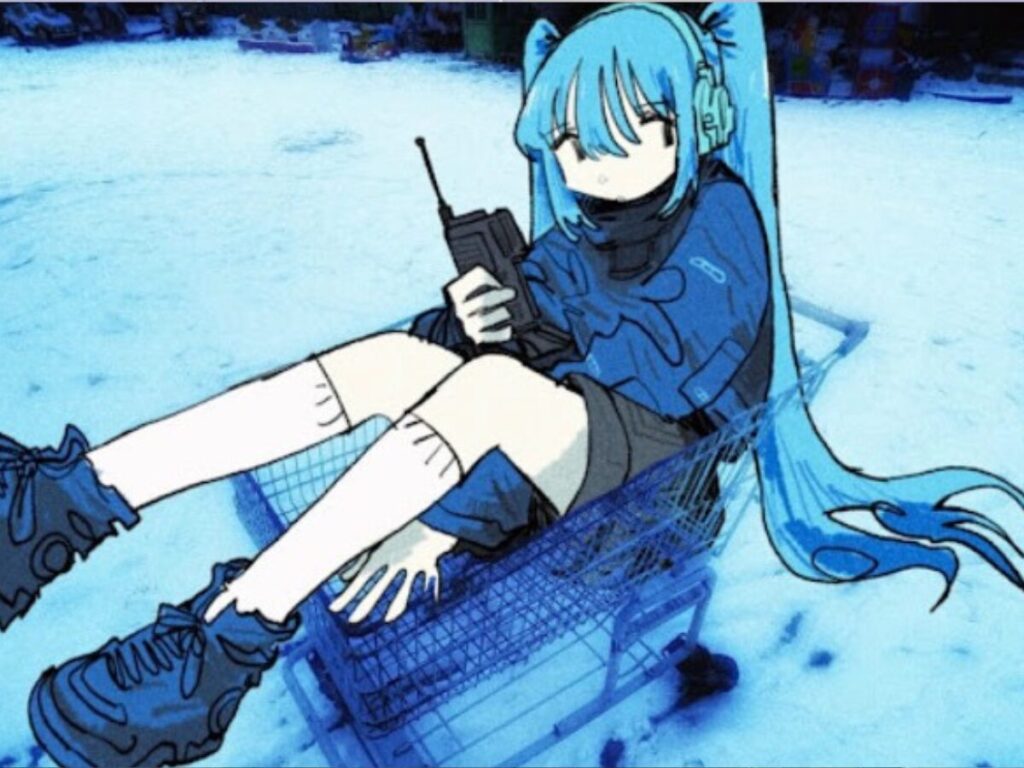
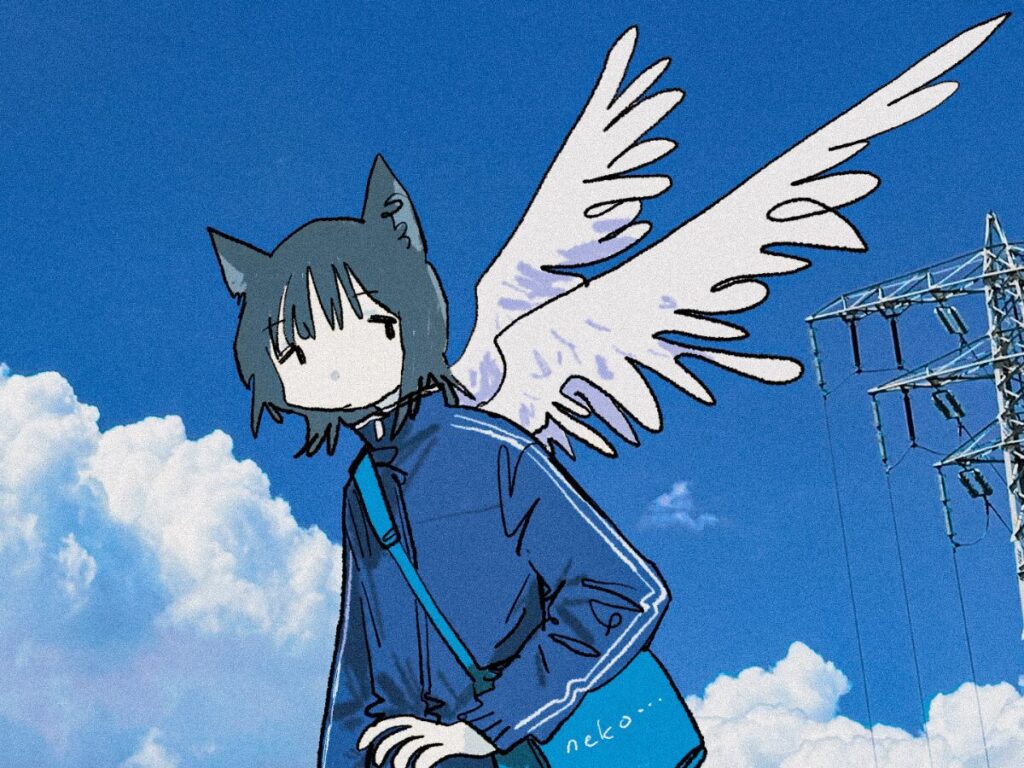
—— The jacket illustration by soyatu brilliantly expresses the “emotional margin” of this work. How did you go about aligning the visual imagery during production?
nerdneko: At the time I made the request, I was still in the conceptual stage and the tracks weren’t finished, so I asked based on visual elements from photographs and the figure in the image. The rough sketch was already remarkably high-resolution, and in fact the sonic atmosphere ended up being shaped by the main visual rather than the other way around. I always get so much inspiration from soyatu’s illustrations.
—— M1 “utopia”: As the opening track of the album, what kind of sonic imagery or scenery did you envision to guide listeners into the world of never mind?
nerdneko: I made it with a cold, sacred sonic image and a scenery reminiscent of distant memory in mind. The jacket photo was taken at an abandoned amusement park, and the contrasts of “glory and decay” I found there, along with the inspiration of a “distant future,” were translated directly into sound. Something like dreaming of utopia within dystopia. I felt that Hatsune Miku’s spoken voice, despite its inorganic quality, carries a certain loneliness and sanctity, so I crafted it with the nuance of an introductory SE that sets the atmosphere.
—— M2 “never mind”: As the title track, the contrast between the roaring guitar and Hatsune Miku’s prayer-like vocals is particularly striking. What part of this song did you focus on most?
nerdneko: I focused on the melody and the beat. The drum phrasing and sound design in particular are probably the most worked-out of anything in my past catalog. I always put effort into melody, but this time I was especially conscious of creating a strength that wouldn’t get buried under the tension-heavy chord work and the bleeding shoegaze guitar sound. It’s a particular favorite of mine.
—— M3 “unletting”: The title “unletting” seems to form a beautiful contrast with the EP’s theme of “the strength to let go.” Could you tell us where this track sits within the EP?
nerdneko: As you point out, the track is contradictory to the theme and title, but it’s precisely in that “conflict” that it finds its meaning. It’s one important structural element for bringing a sense of humanity into the work.
—— M4 “winter song”: Placing this track in the middle of the EP gives the impression of a slight shift in atmosphere. Could you tell us about the imagery and emotions you put into this song?
nerdneko: I went back and forth on the placement of this track, but since the first half of the EP had turned out a bit darker than I’d planned, I placed it here with the intent of a sense of momentum — like mist clearing — and the air of winter. I was born in a snowy region, and the blueness of snow after sunset is so beautiful; I feel I’ve finally been able to express what I wanted to in a winter song.
—— M5 “ether”: The title “ether” evokes a transparent atmosphere and spatial expansiveness. Was there anything you were particularly conscious of in terms of sound design?
nerdneko: I was conscious of balancing transparency and noise. As I’ll mention later, one of the overall production themes this time was how to use distortion in a way that isn’t aggressive, and in this track too I aimed for an enveloping, saturated sense of noise. Like M1, it features Hatsune Miku’s spoken voice, but I think it came out with a different impression.
—— M6 “prayforyou”: Closing with “a prayer for you” is a wonderful structural choice. What kind of afterglow did you want to leave with listeners once the final reverberation of this song faded?
nerdneko: Thank you. I basically believe that interpretation is whatever feels right to each listener, but with this song, I simply hope it leaves people with a gentle feeling. In January of this year I had the chance to travel to Korea for a live show with blue web. (my music unit with yaginiwa), and this song expanded out from the gratitude and prayer-like feelings I had there. I was moved by how something can be communicated across borders through music, and I wrote this song right after returning home, pouring that emotion and heat into it.
—— The layered roaring guitars and deep reverberation form the core of this work. Were there any updates from your past works in terms of gear selection and mixing, or any new challenges you took on?
nerdneko: There weren’t any major gear updates, but for the guitar sound I introduced a fuzz and some spatial effects that I used for the first time. It’s like “using a blade correctly” — I approached thethe sound design and mixing this time with a focus on how to use distortion in a way that isn’t aggressive. I’d been deeply immersed in listening to overseas band sounds for a while, and as a result I feel I ended up with something sonically positioned slightly differently from my previous works.
—— Within a dense shoegaze sound, could you share your approach to tuning Hatsune Miku’s voice so that it doesn’t get buried and yet floats through faintly?
nerdneko: I chose a gentler Miku voice, and I worked through a lot of trial and error with EQ and spatial plugins to make it sit right. If the voice is too thin it gets buried, so this time I was especially conscious of a balance where it doesn’t assert itself too strongly but also doesn’t sink into the mix. The desire for listeners to hear the lyrics is still at the foundation of this work as always, so I want to keep exploring and finding the right answer for each piece. For the next work, I’d like to try tuning within a more minimal track arrangement.
Just as nerdneko puts it — “how to use distortion in a way that isn’t aggressive” — the noise that fills never mind is endlessly deep, and warm. Even while swallowing conflict and the unreasonable realities of the world, his stance of choosing “the strength to let go” through the prayer of music is vividly inscribed in this EP.
Within a Mikugaze scene that is gathering heat across borders, what kind of scenery will he show us next? The reverberation of a gentle prayer directed toward the distant future should continue to resonate in the listener’s heart long after the album has finished playing.