
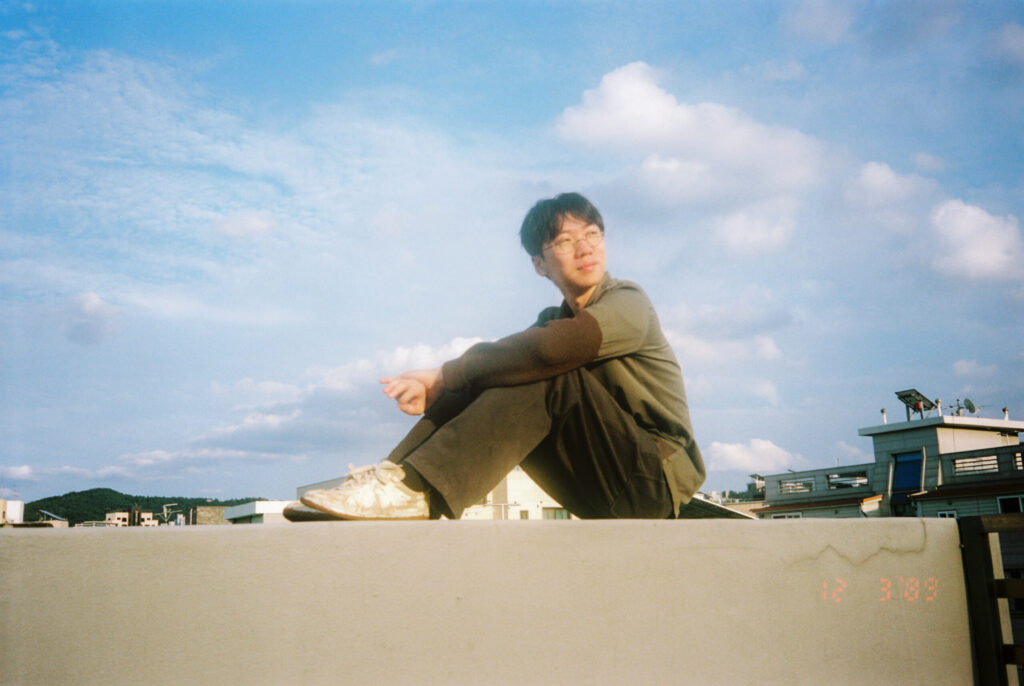
Best known as a member of Silica Gel, one of the key bands in Korea’s indie scene, Kim Chunchu also writes and records under his solo moniker Noridogam. Borrowing its name from a childhood “field guide to play,” the project quietly threads together folk, 60s–70s pop, and psychedelia, turning small, fleeting moments from everyday life into songs that are concise, beautiful, and disarmingly intimate. Ahead of “Truthbuster the Tour,” which connects Seoul with Tokyo and Osaka, we sat down with him to trace how this private “playground” called Noridogam has taken shape, and what kind of thoughts currently lie at its center.
To begin with, could you tell us about the meaning behind the name “Noridogam” and what kind of “play” you had in mind when you first started this project?
The name “Noridogam” comes from the title of a book I used to see every time I visited my cousin’s house when I was a child. The original title means “Asobijukan,” and it’s a book by a Japanese author, but in Korea we read it as Nori-dogam, “a field guide to play.” It contains all kinds of outdoor and indoor games, organized almost like an illustrated encyclopedia.
The way I work on music—being alone with my instruments and gear, creating my own little “catalogue of play”—felt very similar to the games in that book. I think that’s why I ended up using this name for my solo project.
You’re also known for your work with Silica Gel, but if we focus just on Noridogam, what feels most different about how you express yourself in this project compared to the band?
Silica Gel is, for me, both my main career and my life, something I’ve been building with my bandmates—who I could even call my brothers—ever since my twenties. Within that system, I participate as one part of the whole, taking on a few specific “roles.”
Noridogam, on the other hand, is purely my own expression. It’s a project where you can directly see the personal thoughts and direction of me, the musician Kim Chunchu. So I feel much less restrained in how I express myself (separate from the musical “color” itself), and when it comes to my activities or the things I choose to run into on purpose, I allow myself to try them more freely.
Looking back from your first solo releases around 2019 up to now, is there a particular song, record, or moment that you feel was a real turning point for Noridogam?
I think I would have to say the song “무지개 (Rainbow).” In Korea, that track became relatively well-known among a broader audience. I believe the music video was one of the big reasons for that.
It’s not that I suddenly began to feel that “the music video itself is the most important thing,” but it showed me that the public’s response to the kind of song I like—“concise, beautiful, and short”—was actually not bad at all. In other words, it gave me confidence in my slightly maniacal taste of “I want people to like the things that I like.”
Since then, when I write songs, I’ve been able to trust myself a bit more.
People often hear elements of folk, 60–70s pop, and psychedelia in your music as Noridogam. In your own words, what kind of musical “lineage” do you feel this project belongs to, and which artists or works have inspired you the most recently?
I think the two main criteria for music I listen to are:
- songs I want to listen to over and over, and
- methods of expression I’d like to try putting into my own music.
These two things have shaped me into someone who enjoys experimental and avant-garde music, but who is ultimately drawn to seeking out more “genre-based,” legacy-oriented music. Because of that, I tend to pay close attention to the kind of lineage you just mentioned.
So, not only recently but continuously, I listen a lot to Japanese musicians from that era, especially the works of Haruomi Hosono and the many records that carry his production touch. Albums by Yumi Arai have also influenced me a great deal. There are artists like Steely Dan, The Beatles, and Emitt Rhodes as well.
Among 21st-century musicians who have directly inherited those influences, and especially in the realm of post-punk or “haunted pop,” where things sometimes drift into being too acoustic, I draw inspiration from artists like Ariel Pink and John Maus to add a bit more color to that direction.
As Noridogam, you often handle songwriting, performance, and even recording by yourself. What are the most rewarding parts of doing everything alone, and what are the toughest parts?
Working alone actually makes me feel much freer than working with other people or engineers. I’m fully aware that, historically, music is something that passes through the hands of many different contributors—composers, performers, engineers, and so on. But at a fundamental level, I want to approach my work more like a painting: an artwork directly shaped by the artist’s own hands.
That probably comes from my father’s influence. He majored in Korean painting and worked as a special-effects makeup artist, so I grew up close to that kind of craft. Because of that, the freedom I feel, and the time I get back as experience through the process of working alone, are extremely precious to me.
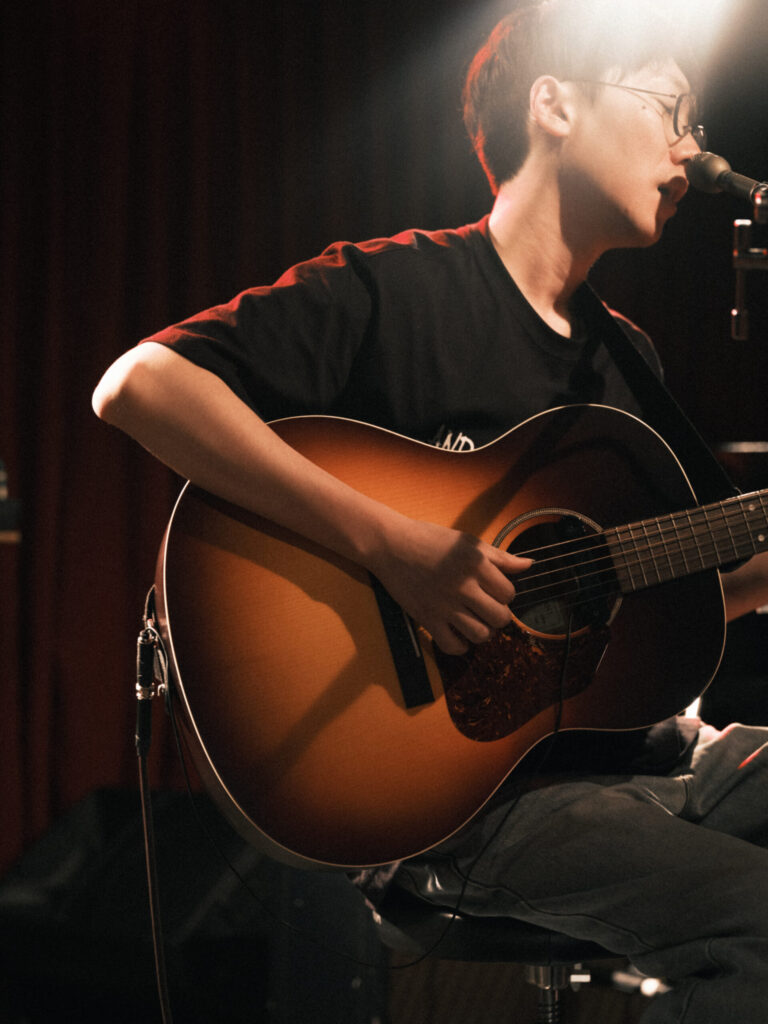
photo by Hayato Watanabe
On the other hand, working alone is both great for filling the music with many sides of myself and, at the same time, limiting in terms of expression and ideas. To address that, on the album Truthbuster, which will be released on March 17, I recorded together with various musician friends who are also joining this tour. I think that allowed a slightly more complex palette of colors to enter the music.
Many Noridogam songs feel like they capture very small, fragile moments from everyday life. How do you usually collect those moments, and at what point do you decide, “Okay, this should become a song”?
Whenever I have time, I pick up my guitar or hum melodies. If something comes out that I like, I record it on my phone and later take it out again to listen. When a particular situation or thought leaves a strong impression on me, I jot it down in a memo.
Looking at it that way, I think those “sudden thoughts” that come from everyday life are a really important element in my music. I sometimes think of them as something like essays. Maybe that’s why my songs contain impressions and fragments of stories that even I can’t fully define.
Rather than stating clearly what those thoughts are, it’s more like leaving a record that says, “I just happened to feel this way,” and wanting to share that record with other people.
With “Truthbuster the Tour,” you’ll be playing in Seoul, Tokyo, and Osaka. What would you say are the key things people should pay attention to if they want to really experience a Noridogam live show on this tour?
On this tour, I’d like the audience to feel a stronger sense of “closeness.” By that, I mean both physical distance and the atmosphere of a natural, free performance, where the stage where the music is played, the instruments in the musicians’ hands, and the moments created by the ensemble between me and the band members can be felt more directly by the audience.
That’s the part I personally find most moving when I watch other musicians’ shows, so I really want to convey that feeling as directly as possible.
Within this tour, how do you see the upcoming show in [CITY / DATE] in particular? Is there anything, in terms of setlist, atmosphere, or how you want to use the venue, that you’d like to do differently compared to the other dates?
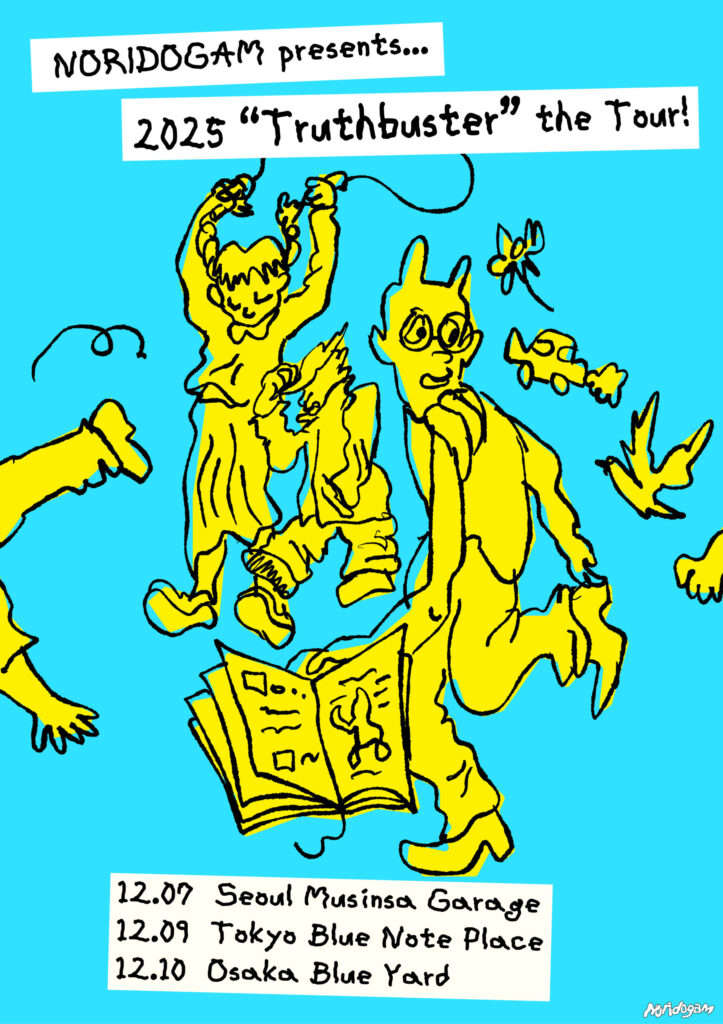
First of all, the show in Seoul will have a relatively longer running time, so we’re planning to perform as many different songs as possible.
In Tokyo and Osaka, because of the characteristics of the venues, each show will have an intermission and be divided into two “acts.” We’re currently preparing a structure that lets us play as many songs as we can while still allowing the first and second halves to flow naturally into each other.
Also, Blue Note Place and Blue Yard are quite different from a typical live house, so I’m really looking forward to how close the breathing between the stage and the audience will feel there.
Through Silica Gel, you’ve already played shows and festivals outside of Korea. How has that experience of performing abroad with the band influenced the way you see things and the way you create music as Noridogam?
As we’ve gradually played more shows overseas, I’ve come to feel that “live performance” is one of the most powerful weapons a musician can have. As a music fan myself, I love listening to recordings, but there’s nothing that delivers a band’s music as intensely as seeing them perform right in front of you.
So, when I work on Noridogam’s music, I always try to balance two things: imagining how the songs will be performed on stage, and exploring the expanded possibilities of expression in recorded form. Usually, the former leads me to choices like keeping the live arrangement more minimal, while the latter leads to choices like layering various instruments in the studio.
Through your shows in Japan and the response from Japanese listeners and media, what kind of “connection” or chemistry do you feel between Noridogam’s music and the Japanese audience so far?
I haven’t had that many chances to perform in Japan as Noridogam yet, so I feel there’s still a lot of exchange to be made. But I do sense some differences between Japanese and Korean audiences in how they experience live shows.
For example—though of course this isn’t true for everyone—my impression of Korean audiences is that many people are part of a very strong fan base, which makes the energy in the venue extremely hot. Based on my experiences in Japan, I’ve felt that many people, regardless of age or gender, simply come to the live house itself to enjoy music.
I feel that’s one of the differences between the two, and because of that, I’m expecting there will be quite a few people who are seeing Noridogam live for the first time. I really want to leave a good impression on them. I’m sure that Japanese music fans will enjoy Noridogam’s style.
Are there any books, films, games, or even specific places you’re into right now that might help people understand who you are as Noridogam at this moment?
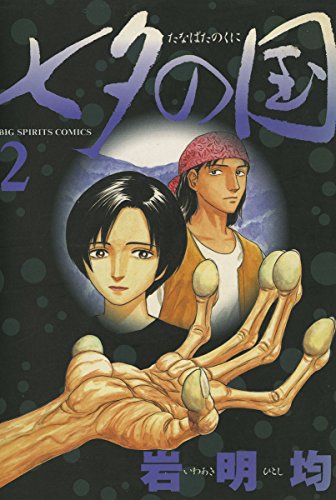
I really like games, and I also love Japanese games, IPs, and manga. Recently I reread Tanabata no Kuni by Iwaaki Hitoshi, who is well known for works like Parasyte and Historie. I’m such a big fan of his that I reread his works quite often.
In both your band and solo activities, do you have any personal “rules” or little rituals that you always try to keep?
I’m the kind of person who thinks a lot. Ever since I was young, I’ve been the type to plan things extremely thoroughly and prepare for a long time. That has the advantage of letting me anticipate and prepare for various situations, but on the other hand, I also have memories of missing good timing because I wasn’t very good at actually putting those plans into action.
So, after becoming an adult, I started telling myself, “Rather than thinking too much, let’s act first and then respond quickly to whatever unexpected things come up.” I’d say that’s one of my most important mottos.
Lastly, is there anything you would like to say to listeners in Japan, and to people who might be discovering Noridogam for the first time through this interview?
It feels like this turned into quite a long interview, but I hope it has answered some of the questions that Japanese music fans, and those who already knew Noridogam, might have had.
For those who are meeting me for the first time through this piece, I’d be very happy if you could look forward to my music, the upcoming singles, and the album that will be released on March 17. I hope we can meet again through streaming platforms and at future shows in Japan. Thank you very much.
Rather than overthinking until the timing is gone, take the first step—and then stay nimble in the face of whatever happens next. The personal motto Kim Chunchu shared in this interview feels deeply connected to the gentle intensity that runs through Noridogam’s records and live performances. With new singles on the way and the album Truthbuster set for release on March 17, there will soon be more pages to turn in his own “field guide to play.” For listeners in Japan who are meeting Noridogam now, this feels like the perfect moment to start following those small, fragile moments he turns into song.