
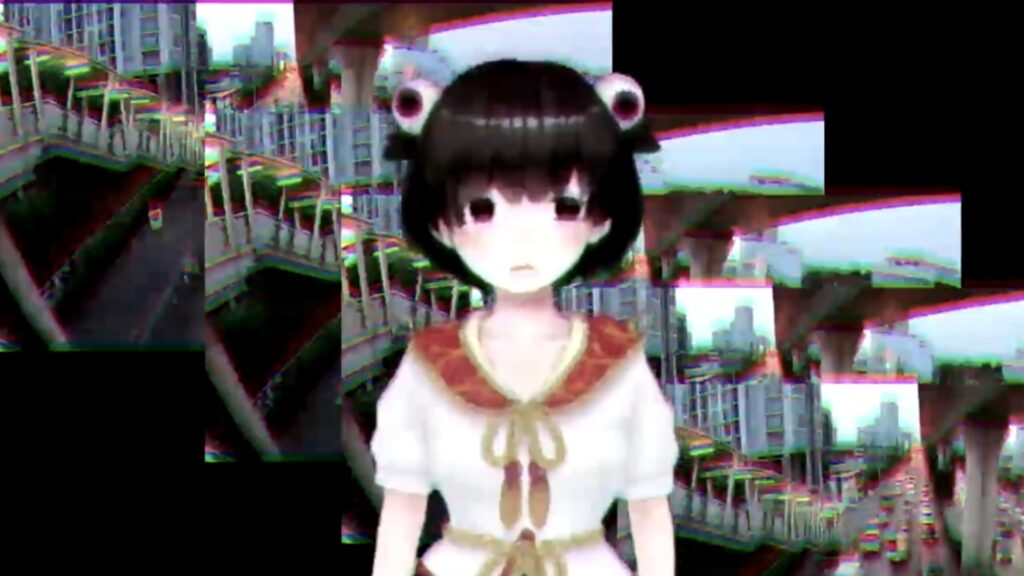
THE LUV BUGS × Madobe Rika: Where Internet Culture and “Bugs” Collide in “bootleg wonderland”
Behind the uniformity of the hit charts lurk extraordinary talents whose overwhelming energy makes them seem like “bugs” in the system. THE LUV BUGS, a project dedicated to spotlighting artists who refuse to fit within the boundaries of the mainstream, has released its striking new track, “bootleg wonderland.”
Who exactly is Madobe Rika, an artist whose formative influences lie in the aesthetics of Aphex Twin and Susumu Hirasawa, as well as the depths of the internet, including 2channel’s “Sharekowa” horror stories and the Deep Web? We explore the story behind this collaboration between unconventional talents, along with the singular, uncompromising philosophy that allows them to survive within today’s rapidly consumed internet culture.
First, could you tell us about the THE LUV BUGS project? What kind of experience—or “bug”—do you hope to deliver to listeners?

malo: Going back to the beginning, I originally came from dance-music scenes such as hip-hop, house, techno, trance, and drum and bass. Then, by chance, I ended up working with livetune, who became the first Vocaloid producer to make a major-label debut. At the time, hip-hop, dance music, and the early Vocaloid scene were far from mainstream. From the perspective of the music industry, they were subcultures that made people ask, “What is this?”
The core members of THE LUV BUGS come from similar backgrounds. That is precisely why we want to work with young artists who may not currently be part of the mainstream, yet possess distinctive musical identities and talents capable of resonating globally. We are interested in people who pursue music with their own uncompromising vision and creative purity, rather than making pop music designed specifically for the charts. In a positive sense, we define those people as “bugs.”
Of all the talented artists out there, why did you choose to work with Madobe Rika and TORIENA for this project?
malo: To put it simply, when I first heard Madobe’s music, I thought, “This is insane.” I could not believe someone was making music this unhinged and distinctive. It was not a rational decision. After listening to the entire album, I genuinely felt that it was completely “bugged out,” so Madobe was the first person we approached.
At the same time, the music is sonically difficult for an ordinary vocalist to perform. TORIENA already had a relationship with us, was active in metaverse spaces such as VRChat, and possessed the kind of sharp edge needed to bring this world to life. We felt that she could make it work. On top of that, Toshitaka Shinoda of Ijigen TOKYO, who directed the music video, was already a huge fan of Madobe’s work. The mutual respect between everyone multiplied, significantly elevating the power of the finished work.
The Aesthetic of “Madobe Rika,” Born from Aphex Twin and VTuber Culture
We would now like to speak with Madobe Rika. Could you begin by telling us where the name “Madobe Rika” came from?
Madobe Rika: The name comes from “Windowlicker,” a track by the British artist Aphex Twin. It combines “Window,” meaning “mado” in Japanese, with “Licker,” which became “Rika.”
My decision was influenced less by a particular devotion to Aphex Twin than by the circumstances behind the creation of that song. I see Aphex Twin as someone who spent years pursuing the world he loved in the countryside. When he eventually presented himself to the general public and the media, “Windowlicker” emerged from the process of reconciling his established style with the wider world. I found that sense of balance, and the way he presented himself as an artist, incredibly beautiful. That is why I used it as the basis for my name.
What meaning does the word “Madobe,” or “by the window,” hold for you?
Madobe Rika: Originally, I was planning to start out as a VTuber. Many early VTubers at the time, such as Tsugu Hatoha and Mito Tsukino, had names combining kanji with katakana, with a character symbolizing their concept included in the surname. Starting from the word “Window,” I searched for a Japanese expression that could instantly evoke the surrounding imagery and worldview. Eventually, I settled on “Madobe.”
Do you have a particular position you want to occupy as an artist, or an ideal you are working toward?
Madobe Rika: My ideal is Susumu Hirasawa. From his years in bands such as P-MODEL through to his work today, he has never been confined by any genre. He has always remained unmistakably “Susumu Hirasawa.” I have always wanted to become a completely singular presence: someone who continues pursuing what they love and attracts fans through that pursuit.
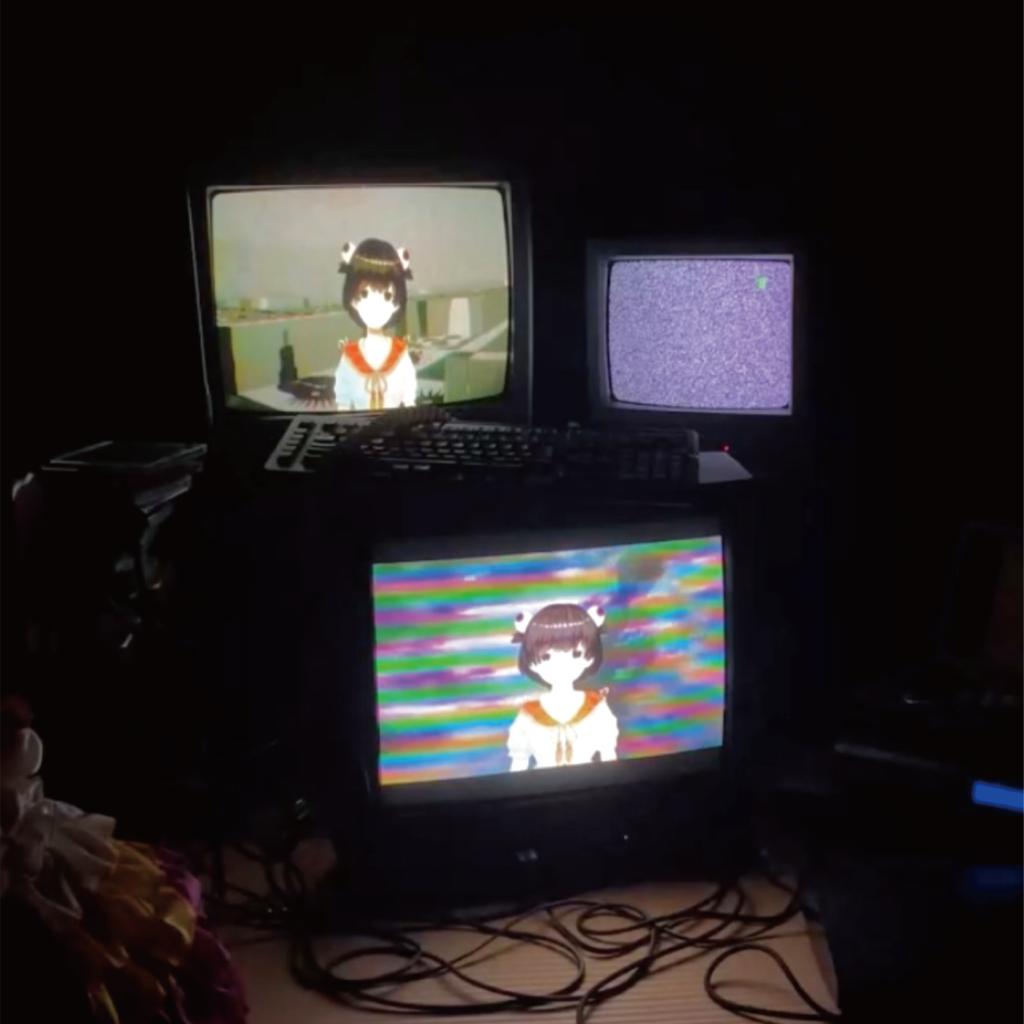
During my live performances, I arrange several CRT televisions and project images onto them. The underlying concept is a mysterious girl who exists within an electronic world, like Lain, the protagonist of “serial experiments lain.” I believe that people do not define their own characters entirely by themselves. Their image is formed through the accumulation of impressions held by others. I consciously present myself as an elusive “electronic diva” who appears completely different depending on the person looking at her.
The World of “bootleg wonderland,” Woven from the Deep Web, Sharekowa, and Science-Fiction Films
What was the concept behind the production of “bootleg wonderland”?
Madobe Rika: I generally begin by constructing a world. This track started with the idea of combining two seemingly unrelated sets of motifs: “Alice’s Adventures in Wonderland” and the “Deep Web, malware, and pirated software.” Toshitaka Shinoda of Ijigen TOKYO directed the music video and translated that world beautifully into a school computer room, portrayed as the only place where the characters can access the internet.
The lyrics are also highly memorable, with their succession of technical and esoteric expressions, including phrases such as “the ID of Clown Town.”
Madobe Rika: Most people know that the Deep Web exists, yet very few have actually interacted with it. That is exactly why I thought filling the song with incomprehensible words would help create the right atmosphere. I gathered every technical term related to the Deep Web and malware that I could remember, then combined them with the worlds of Mother Goose and Alice.
Were there any particular elements of the sound that you focused on?
Madobe Rika: Shortly after the second verse begins, around the lyric “antigravity experiment,” there is a section with an extremely heavy bass sound. I had a lot of fun making that part. There was a horror-meme sound that became popular online overseas, and I wondered how it had been created. When I researched it, I discovered that it was made by taking the creaking sound of a door opening and closing and lowering its pitch dramatically. I imitated that technique and applied some strange phase effects to create a thoroughly perverse sound(笑). I often draw more inspiration from ASMR and sounds found online than from music itself.
What kinds of culture outside music have influenced you?
Madobe Rika: The core of my identity comes from “2channel.” I especially love the atmosphere of “Sharekowa,” short for “Shinu Hodo Share ni Naranai Kowai Hanashi wo Atsumete Minai?”—a thread dedicated to collecting terrifying stories that are no laughing matter—on the occult board. Faceless strangers would gather late at night and continue engaging in disturbing exchanges while maintaining a strange emotional distance. That uniquely unsettling atmosphere of the internet has had an enormous influence on my music.
I also love science-fiction films. I am drawn to works that explore how to express higher dimensions and multidimensional interpretations, such as Christopher Nolan’s “Interstellar” and Denis Villeneuve’s “Arrival.”
Internet culture is currently consumed at an extremely rapid pace. How do you feel about that?
Madobe Rika: *I also find the current fast-food-like pace exciting. New things are constantly being consumed, while older works can suddenly be rediscovered and take off. For example, the Witch House group Crystal Castles suddenly underwent a resurgence as the popularity of Phonk grew.
Artists do not necessarily need to force themselves to study whichever sounds are currently trending. When you continue pursuing what you genuinely love, a moment can suddenly arrive when that work is picked up within this chaotic, rapidly changing environment. I think this has become a good era in which artists can continue making what they truly want to make.
The “Synchronicity” That Occurred During a Music-Video Shoot at an Abandoned School
Finally, could you share your thoughts on this collaboration?
Madobe Rika: When I heard the concept behind THE LUV BUGS, I decided to make a track that used extensive digital glitches and would immediately make listeners feel an unsettling sense of “What is this?” The direction was close to what I usually do, so I was able to spread my wings and create with a great deal of freedom. Everyone, including malo, gave 100 percent, and I believe the work was completed through an almost miraculous balance.
malo: Madobe’s commitment to building a world with a highly refined and uncompromising core, rather than chasing trends, was exactly what THE LUV BUGS had been looking for.
There was actually something that happened when we went to an abandoned school in Chichibu, Saitama, to shoot the music video. On the entrance to one of the classrooms in this school, which otherwise had absolutely nothing to do with music, someone had inexplicably attached a photocopy of the cover artwork for Aphex Twin’s “Windowlicker,” the song that inspired Madobe’s name. It was sitting there all by itself. The moment I saw it, I got goosebumps and thought, “We were guided here!”
Madobe Rika: *It really was unbelievably funny. It was not even a genuine poster. It was simply an unauthorized photocopy stuck to the wall, which gave it this wonderfully outlaw quality.
That truly sounds like a fateful episode embodying the concept of this project. Thank you both very much for sharing your valuable insights with us today.